Friday, December 16, 2011

What Does Forgiveness Look Like?

I've asked the non-verbal part of my brain to tell me what it knows about forgiveness.

You may have noticed that I am highly verbal. I remember, as a child, narrating my life out loud. ("She walked across the street." I remember exactly what street I was crossing when I realized I was narrating.) My tendency toward the verbal is the reason I'm a writer. As soon as I've written it down, I know what I'm thinking. Before that, it's a bit vague.

On the other hand, if I put words around something, it becomes trapped. For instance, if I call something "unforgivable," it's hard to open to other possibilities.

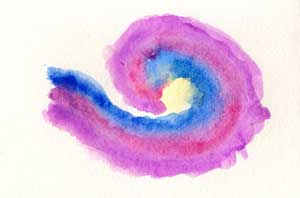
My first image of forgiveness was light flowing through an open heart.


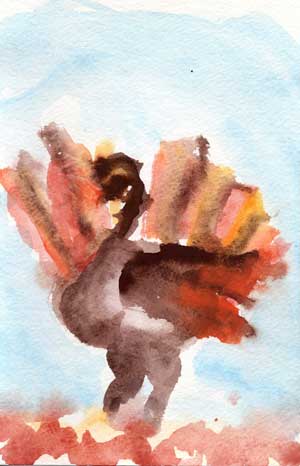
I wasn't happy, however, with the painting.  I hardly ever like my paintings when they include known symbols or are representational. (In addition, something about this yellow does not say "light" to me…)

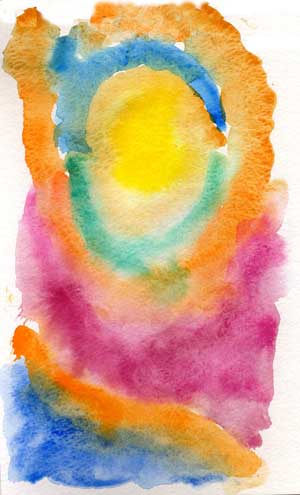
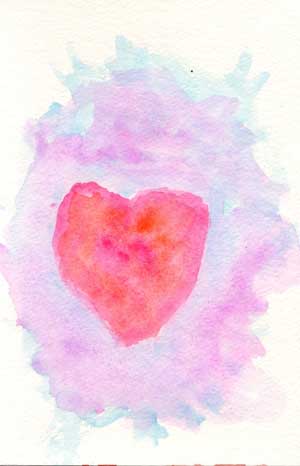
My next try
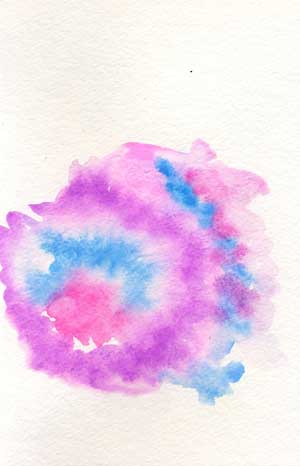


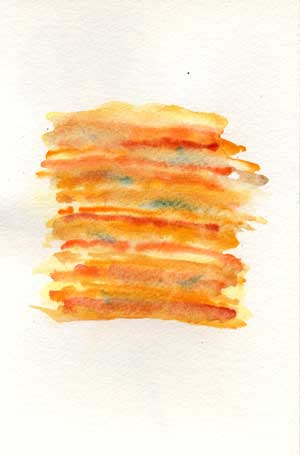
 was more successful. It's prettier and it taught me more. This painting tells me that forgiveness is a softening, an opening. Sharp bits still exists, but now they give energy to the whole instead of making it hard and inflexible. Thinking about forgiveness as a process produced this:


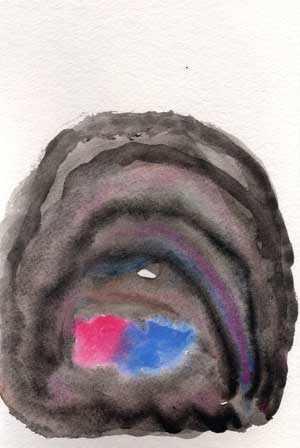
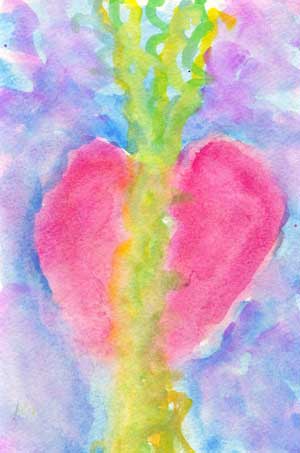
On the left, the darknesses of life are pressing in on the light. What is unforgiven causes shadow and constriction.

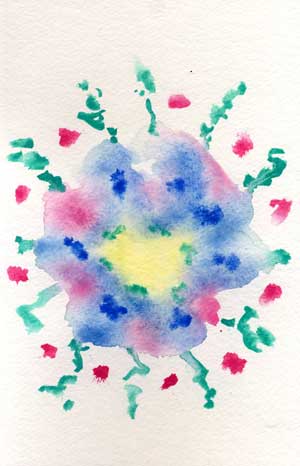
In the center, forgiveness begins. The darkness is breaking up. Light is spreading, but things are chaotic and unsettled.

On the right is forgiveness. Light shines throughout. Though darkness is present, it has become a part of the whole. 

The light shines in the darkness, and the darkness has not overcome it. (John 1:5)

Friday, December 9, 2011

Forgiveness—Early Observations and Experiments

My kind promise is "to forgive with wild abandon." I chose the phrase because I want to forgive with extreme generosity. I don't imagine that I will forgive instantly and effortlessly, but I want to forgive frequently. I want the time between offense and forgiveness to get shorter and shorter, so that the cost to my soul and psyche gets smaller.

We forgive to return ourselves to wholeness.

“To forgive is to set a prisoner free and discover that the prisoner was you.” -- Lewis B. Smedes

How is forgiveness showing up in my life right now?
  • A friend of mine was describing a situation with her stepdaughter.  The younger woman had arrived from out of town for a visit with a companion she was specifically asked not to bring at an hour much later than she was expected. She was sent to a hotel, rather than being invited home.  Hearing the story, I (silently) had many judgments about my friend’s actions which I broadened to her character in general.
      
  • A man working for me did not do what I asked him to do. He made an effort, but the results were not what I had in mind. I told my husband how dissatisfied I was and what an idiot the worker was not to have understood how to do it right. Then I realized that the man was not (as I thought) out of the house and may have overheard my harsh words.
     
  • After both of these situations, I felt terrible for my own tendencies to judge. In fact, the idea that you are continuing to read words written by such a flawed character is astounding.
Simple vignettes, but they are rich with lessons about forgiveness.
  • Expectations:  I have ideas about How Things are Supposed to Go. My friend should have responded to the situation as I would. My employee should have understood what I had in mind immediately.
     
  • Judgments of others: if they don't do it my way, they're wrong. Not only that, but their wrongness reflects defects in character.
     
  • Judgments of myself: to take offense means I am A Bad Person, as does having judgments about the situation or the other person. Saying anything about the offense and/or at the judgments compounds my Badness.

How could it work differently?

  • Would it be possible to meet life without expectations? I'm not sure…
     
  • Having judgments seems like a human activity. I don't think I will stop having judgments. I can become more aware of the judgments as they arise.
     
  • Once I notice a judgment, I can decide what to do about it, including whether or not to say something. In the first example above, it doesn't matter that I would've handled things differently. In the second example, perhaps I needed to better explain the results I wanted.
 
Experiments—try thinking:
  • I'm open to this moment. The next moment also will be a surprise.
  • Whoa, look at all those judgments I'm having!  I'm good at being human.
  • She did it differently; that doesn't mean she did it wrong.
 

Friday, December 2, 2011

It's all in how you look at it…

Art Every Day Month is complete.

"Which way is up?" my husband asked on Day 30. He went on to explain that if he looks at the painting one way people are on their knees in Islamic prayer. If he looks at it another way,  the crowd is looking up.  I was just painting colors and had no idea there were people involved.

Several times this month, I have admonished myself not to use so much water. Also on Day 30, puddles on the paperwork threatened to spill over onto the table .  I dabbed a puddle with a tissue and like the textural result.  The painting became about textures... An emergency response became a goal.

Art reminds me to be in the moment and that there are no mistakes .

 Day 26


 Day 27


 Day 28


 Day 29


 Day 30


Saturday, November 26, 2011

Visual Journaling (Art Every Day Month, week 4)

Art Every Day Month is drawing to a close and I find myself thinking – as I did last year at this time – that I should extend this habit as a kind of visual journal. I have no illusions that I am a Great Artiste. I only know that painting delights and calms me.

Art wouldn't, for me, work as a diay. A year from now I probably won't know that on day 20 I had a migraine.  Art becomes a sort of slow-cooked meditation for me. I lose myself when I'm painting and, when I review a week's worth of paintings, I can accept them without judging. That's a good process for someone like me who often mistakenly pushes against what is.


Day 19


Day 20


Day 21


Day 22


Day 23


Date 24


Date 25


Saturday, November 19, 2011

Self Reflection (Art Every Day Month, week 3)

Several days this week I have had to convince myself to make art. The allure of deciding I was too tired or too sick (I have a cold) was strong. Sometimes painting gave me comfort and energy. Sometimes it was a slog.
Looking back, I see a reflection of my attitude and my energy each day. Art is a mirror.

Day 11


Day 12


Day 13


Day 14


Day 15


Day 16


Day 17
Day 18


Friday, November 11, 2011

Without a Plan (Art Every Day Month, week 2)

If I approach the page humbly and let colors and movement lead me, I like what happens.

If I have a vision and try to create it, the difference between thought and reality frustrates me. Initially, I don't like the results. Over time, they grow on me.

Hmmm, are there life lessons here?

 Day 5 


(malfunctioning marker )


Day  6


Day 7


Day  8


Day 9


Day 10

 Quiz: Which two of the above were planned? ( leave a comment below )

Friday, November 4, 2011

Learning from my Left Brain (Art Every Day Month, Week 1)

I have committed, once again, to Art Every Day Month. As before, I need to decide what that's going to mean to me. What can my body do this year, this day?

I have my paints and paper out on the table where they are easy to reach.  I approach with no expectations, except to put paint on brush on paper. I am learning already.  Here are some lessons:

Day 1: hey, I can do this!

Day 2:  I am happier with abstracts and than trying to do something representational... Even if it's impressionistic. I
Day 3:   Took my daughter's advice to paint a teddy bear . imimmediately disliked, but it's growing on me . I'm not sure what thlesson is yet…  
Day 4:  color makes me happy!


I am so wordy.  This month I get to be quiet and listen...