Friday, December 31, 2010

Inviting Change: The Power of Less (book response)

[I have decided to post a few notes about a book before I mention it in my monthly newsletter. This is not a review of the literary value of the book, but rather a record of the response I had while reading it.]


The new year invited me to think and read about making positive changes. That's what New Year's resolutions are all about, right?

I was reminded what dangerous territory the idea of change is for me.

My adult life has been organized around coping with changes thrust upon me by living with a chronic illness. What with changes engendered by living at the turn-of-the-century and living through an uncertain economy, etc., most human beings are coping with enormous amounts of change. The new jargon for grace in response to change is "resilience." Building skills in this area is a survival mechanism for all of us.

But what about inviting change? I've been spending time recently with a book called The Power of Less, by Leo Babauta.

I was attracted to the book because Babauta is the author of the popular blog Zen Habits. I hoped he would not get too aggressive and heroic with his advice about how to make changes.

The book does, indeed, take a gentle and sane approach to change. Babauta encourages us to identify what is essential in our lives and eliminate the rest. It is about simplification.

I enjoyed and was inspired by the first 60 or so pages and then found myself getting into trouble. It took me a few days of processing (I'm not the fastest heifer in the stampede) before I realized my difficulty and made accommodations.

Babauta's Power of Less Principles-- and his explanation of them-- are fine:
  1. Set limitations.
  2. Choose the essential.
  3. Simplify.
  4. Focus.
  5. Create habits.
  6. Start small.

In the second part of the book, "In Practice," he gives examples of how to apply the principles in various areas of our lives. I found myself getting more and more frustrated with this section, until I identified my difficulty.

My problem, it turns out, is that I have little control over the practicalities of my life. I can't, for instance, get up half an hour earlier and create a new morning routine without inconveniencing several people. I have to have help to get out of bed, get dressed, have a cup of tea… I have to have help with pretty much everything on his morning routine list. I ran into similar trouble with many of Babauta's suggestions.

I returned, as I often do, to the safety of the serenity prayer: God grant me the serenity to accept the things I cannot change, the courage to change the things I can and the wisdom to know the difference.

Babauta's book encourages us to think about goals and projects. To his process, I need to add:
  1. Identify tasks wherein I have control.
  2. Identify tasks with which I would need to ask for help.
  3. Decide with which tasks I am willing to ask for help.
  4. Identify potential helpers.
  5. Ask for help as decided.

My experience is that asking for help comes with a cost. If I have consciously decided to ask for help and accept the cost, then I will find it easier to make the changes I want to make.

Babauta's emphasis on focused, small, present-oriented changes makes it a good fit for someone like me who is working within limitations. As with most life processes, however, I have to take a little extra time to tailor his suggestions to my specific needs.

Friday, December 17, 2010

Working with a Broken System

What does living with disability teach me about working with a broken system?

This week I had the opportunity to bang into two broken systems.

First, the public health nurse who came to do my annual PCA evaluation (wherein she evaluates whether I still need the services of a personal care attendant) asked if my husband and I had discussed getting divorced so that, when I have to quit work, I will be able to continue to have a PCA. Second, I rode Metro Mobility, our local paratransit system and waited for my ride for an hour beyond the promised pickup time.

As I was bumping along in the bus, I realized I'm going to have to get better at working with broken systems. The good news is I'm not alone.

I googled "broken system" and discovered that I am surrounded by them. Our financial, immigration, education and healthcare systems have been described as broken…and that's just the first page of results!

So, hmm, what do I know about broken systems? Oh, right! I live in this body, which some people would no doubt describe is a broken system. Can't get much closer than that.

Learn as much as you can handle

Knowledge is power. The more I learn about how this system works, the more resourceful I will be in response.

On the other hand, there is more to know than I can take. I have to look at the big picture and make some guesses about what knowledge will be the most helpful. I have to learn a piece at a time or I get too overwhelmed.

Identify the experts

There are people who already know a lot about the system. If I can figure out who they are and talk to them, they can help me learn more quickly and efficiently.

I also need to remember that some of the experts do not have titles or letters behind their names. They are, as jargon has it, "consumers"-- those folks who have wrestled with the system from the inside out.

Notice what's working

Broken systems are so obviously broken that it's easy to miss what's working. I need to pay attention to what goes smoothly and easily. When I find those things, I need to:

  • celebrate!
  • thank the folks who are doing a good job
  • think of ways I can strengthen these pockets of righteousness. (See "advocate" below.)

About what's not working...

What's glaringly obvious about a broken system, of course, are all the things that are wrong with it. When I bump into those things, I can ask two questions:

  1. Can I make it better?
    If yes, then hahloo hahlay, I should just have at it! If no, see question #2.

  2. Could I fix it if I had help?
    If yes, then I can rally the troops and take action. If no, see question #3.

  3. Do I know who can make it better?
    If yes, then I can contact them, let them know what I see is wrong and tell them any ideas I have about how to fix it. This is called advocacy. Unfortunately, many of the consumers of broken systems are unable to do it because of lack of knowledge and resources (including personal energy). If I can do it, I should! (Real Genius fans say it with me: "it's a moral imperative.")

    If no, then I can do research to try to find out who can influence this system.

What if it just stinks?


Suppose I can't--even with help--do anything, my advocacy efforts have come to naught and the system is still broken?

Sometimes, the best offense is a good defense.

I need to protect myself, body, mind and spirit.

Having learned about the system and identified the experts and influencers, I can figure out what rules (nonsensical though they may be) are in place that might help me get what I need.

I can bear in mind that broken systems often don't make sense; it's not necessarily that something's wrong with me.

I can cultivate a state of mind and spirit that allow me to exist amidst the chaos. I need to put some thought, creativity and effort into creating my "bureaucratic happy place" whence, faced with the inequities and complexities of the broken system, I can retreat.

As it turns out, I have a lot of ideas about working with a broken system. Isn't it great (sarcasm) that I will have so many opportunities to practice them!

Friday, December 3, 2010

Trusting in Here and Now

Art Every Day Month, Days 27-30

It is December. I am embarrassed to admit I have been wondering what to do about December for days. Art Every Day Month is over. Will I stop making art? Will I stop the other behaviors (meditating, exercising) that I connected with making art?

I have to laugh at myself. I decided to make art every day. There was no one making me do it and there is no one grading me on my participation. My thought, "where do I go from here?" is only a thought. It pulls me into a future that has not yet arrived. If I stay in the here and now, I will be all right.

Here is what I did the last four days of November.

  1. Texture again
  2. Experiment with an object
  3. Meditation on Strong Feelings
  4. Following the Hand 11-30-10
Today is December 3. I painted yesterday and the day before (in a new notebook I bought). I painted because I picked up the brush and painted.

With the new notebook, I created some new rules.
  1. I don't have to create something new every day. I can add to a painting done on an earlier day.
  2. I don't have to use only one piece of paper every day. (I bought three notebooks.)
  3. I don't have to blog about what I create every week, nor do I have to scan and post the results.
I have thoughts about where to go (and not go) from here with my painting that have been generated by what I've done over the last 30 days. (Day 28 was an experiment that definitely gave me some ideas.)

Those are thoughts and ideas. I can welcome them with "curious attention" (as one of my favorite meditation guides would say).

When it comes to continuing to paint in the coming month, I just need to pick up the brush.


Saturday, November 27, 2010

Not precious and precious

Art Every Day Month, days 20-26

  1. The Open Door
  2. I'm Tired!
  3. Texture
  4. My Healing Story now (lower right)
  5. Body Scan 1
  6. Body Scan 2
  7. Following the Hand 11-26-10
Not Precious

Twenty years ago, I was a fan of a photographer named DeWitt Jones who wrote a monthly column that combined photography advice and zen philosophy. (Googling him now, I am pleased to discover he is a hugely successful photographer and speaker.)

One of the things that impressed me about him was that he would take hundreds of photos, unconcerned about the cost in time and film, in order to get one beautiful image.

Making a painting every day has reminded me of that approach. If I work for several months on a painting,it's easy for it to become precious to me… All that time spent and all those decisions made.

The rhythm of my life does not allow me to spend huge amounts of time on a painting each day. They have to be made quickly in between other dailyness.

They become less precious. There is another one coming tomorrow.

Precious


On the other hand, when I look at them closely, when I spent time with them, I discover parts that delight me. On day 22, I remembered how much I like texture in paintings. I have been enjoying the simplicity of some of my output this month (example: day 19), but I was missing the complexity of multiple layers and marks. Day 22 is my favorite of the week. When I look at the state of the paper, however, smudged and marked with paint from other days, I wish I had treated my little notebook with more care and respect. That piece would look so lovely against pristine paper.

I took a workshop with writer Natalie Goldberg. (Also about 20 years ago… I confess to a secret enjoyment of how much older these people look now. What? The mirror, you say? Pshaw!) She encouraged people to write-write-write, to trust that there was more where that came from. Then, when people came to read their work aloud, she asked them to read slowly. encouraging them to caress each word as it came from their lips.

Not precious. Precious.

Painting, writing, living, loving with wild abandon as if there can always be more, as if the Source has no end.Yet slowing down to appreciate each shining drop and understand its holiness.


Friday, November 19, 2010

More Surrender Equals More Beauty

It is still Art Every Day Month.


  1. Vibrant Energies
  2. Following the Hand 11-14-10
  3. Hot Chocolate
  4. Loving Kindness
  5. Behind My Eyelids
  6. Mandala 11-18-10
  7. Moving On...

During the past week I have noticed that, when I try to control the marks I'm making, when I try to be very deliberate, I like the product less. I am clenched around what's happening and the tightness shows. When I paint without an agenda, just following the hand or starting with a vague notion, I find the results more beautiful.

I thought about calling this post "Less Control Equals More Beauty."  Then I thought about the results of lack of control in my life: working too much, saying mean things, etc. That lack of control does not produce good results. I chose the word surrender instead.

I am not trying to control the marks, rather they are being pulled out of me by the idea or the emotion that I'm trying to express. Surrendering to that process makes the work more fun and the results are more beautiful.

Art imitates life.


Friday, November 12, 2010

My Hand in Curious Motion; A Kiss and a Promise

Art Every Day Month, days 6-11


  1. Still in love with sumac leaves.
  2. Playing with Prismacolor sticks.
  3. Entranced by fall foliage.
  4. Sunset.
  5. Purple berries and green leaves. I love
    purple and green.
  6. Ispired by hearing Lynda Barry on
    NPR.
  7. What are the colors in this paint set?
My Hand in Curious Motion

Yesterday, my Delight of the Day was listening to Lynda Barry on NPR'sTalk of the Nation. I was driving home from work and there she was. I've never heard of her before, but waited in the car until the interview was over.

Her new book is about doodling your way out of writer's block. She is sure that moving our hands to write or draw causes our brains to think in different ways than they do otherwise. It was one of the callers who inspired me.  A political cartoonist, he talked about getting his ideas from his "hand moving in curious motion."

When it was time to do art, I let my hand lead, doodling with a paintbrush.  My hand definitely moved in curious ways, making marks I would not have expected. That day's image continues to call to me.  I want to work with it more but decided to move on today because it feels like I need to live with it for a longer before I know what I want to do.

A Kiss and a Promise

Moving on made me remember a phrase my mother used when she felt that the house needed to be cleaned but we didn't have time. "Just give it a kiss and a promise," she would say, meaning that we would come back later to do a more thorough job.

It's a wonderful expression, especially for those of us who would like to be perfect. It's not that I'm doing a bad job. It's not that I'm abandoning my "need" for quality. Instead, I'm doing the best I can for now and moving forward with the intention of coming back.

The kiss is respect for the present moment; the promise is resolve to live in hope.


Friday, November 5, 2010

Love the One You Are (Art Every Day Month, Days 1-5)

I have been pondering why it is so hard for me to do the things I want to do and the things I know are good for me to do. I want to do them so why don't I? It seems like it should be effortless. Yet, I will do any number of things, frittering away my time and my life, rather than do those things I say I want to do (art, writing, meditation and exercise, to name a few).


On October 30, I screwed my courage to the sticking point and signed up for Art Every Day Month 2010. I have been thinking about it (and the monsters had been arguing against it) for weeks. One of my heroes is Leah Piken Kolidas, an artist who writes the Creative Every Day blog and who invented Art Every Day Month eight years ago. Her intention was to create some art every day for one month and post it on her blog. She invited others to join her. This year more than 100 people are participating. (I used her widget to sign up but I am not listed… More about that later.)

I used this as an excuse to get some new toys. I bought a watercolor paper notebook and a new tray of 48 watercolors.
 
Results:
 
Here is what I produced during the first five days of AEDM:


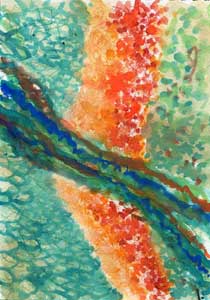
  1. There is the painting inspired by the abscission cells of the last post.
  2. Delight of the Day: bare twigs against the blue sky.
  3. Still delighting in the fall.
  4. This one was about colors and paint.
  5. I looked at the paint tray and used the colors I hadn't yet used.
Rules

Leah provides some very generous rules for AEDM, but I had to add some of my own.
  1. Keep things simple; make it easy.The reason I chose a watercolor tray with because it's easy to start and stop using it. I don't have to spend time getting things ready or cleaning them up. That's also why I put the materials right where I will see them when I come in the door.
  2. Allow beginner's mind. "Do you know what you're going to do?" asked one of my friends upon hearing my plans to participate in AEDM. No. I am purposely facing the blank page with no plan. As soon as I get home, I take the dog for a walk and then I come in and paint. Sometimes, I am inspired by what's outside. Other times, I have started with
  3. Attach a target behavior to a habit. I take the dog out every day, so I made a rule that I would meditate as soon as I got inside and make art right after that. So far, that is working, but here comes the weekend when my schedule goes wacky and I will need a plan...
  4. Don't compare. This is an old 12-step adage and one I need to hold close.I subscribe to Leah's e-mail feed and, after looking at her beautiful productions, the monsters started shouting about what a crappy artist I am.  I had to take a deep breath and continue on.
  5. Remember why. When I revisited Leah's website, I discovered that my name was not on a list of those participating. Foo! I wanted recognition. I wanted to be on that list with other people who make good art. But why? Am I doing this to impress? No. I make art to practice the creative process and learn from it and that's what I'm doing here. Remembering that, results and recognition become less important.
Dealing with the Monster Voices

I know I will spend significant time this month with the not-good-enough/why-bother monster voices as my companions. In case you haven't noticed, anyone can make art better than mine. There really is no earthly reason for me to continue this charade… Etc.

About that time, I started hearing (in my head) Crosby Stills and Nash singing "Love the One You're With."

Today, when I was scanning in my results and the monster voices were very loud, I successfully shut them up by looking at parts of the paintings.

For instance, the first day's painting (which I really don't like):


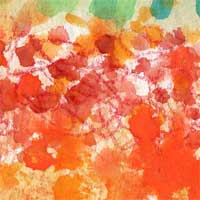
Became this:


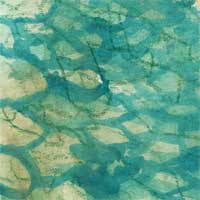
And this:


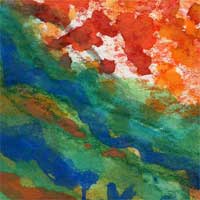
And this:


Now those I like!

If I can't produce the art I love, I need to love the art I produce.