Showing posts with label illness. Show all posts

Friday, March 30, 2012

Reinvention: Illness, jealousy and mudita

When I first began walking with a cane, I would watch others with a real sense of witnessing a miracle. My ankle joint no longer worked (“drop foot”) and I used the cane to steady my uneven gait. Other people were able to lift their foot completely off the ground swing it easily in front of them, place it gently on the surface and shift their weight to it – all without thought. It was magical.
Now, as my hands began to fail me, I am not as spiritually evolved. I am just plain jealous. I watch people take notes at a meeting and find myself becoming resentful and angry.
I am envious of health and those who unthinkingly possess it.
I am learning not to sit in judgment of this process, but to imagine that I am a dear friend. Of course I’m jealous; it makes  sense! How natural to wish that I were healthy. How understandable to resent those who don’t appreciate what they have. Those emotions come from grief over what I’ve lost and fear over what I may yet lose. This is not the time to beat myself up.
What, then?
The Buddhists have a wonderful concept: mudita. There is no exact English translation. The idea is “sympathetic joy.” When I see someone else who is happy, I share in that happiness. When I see someone writing without effort, I celebrate their ability.
This is made easier if I truly believe that we are all one. The idea that we are cells in a larger creature is one of my core beliefs. I am a tiny part of a miraculous whole. So are you. Your strong and able hands and feet and my weak and faltering ones are movements in one dance. Considered this way, I can be grateful for both of us.
I have added mudita to my practice. It works like this:
I feel jealousy and resentment arise as I watch others move,
I take a breath
I say (silently), “May you move gracefully forever.”
I picture my heart as a waterlily opening to embrace the universal whole

electronic illustration: Lotus opening to the universe

Friday, March 2, 2012

Surrender and Illness

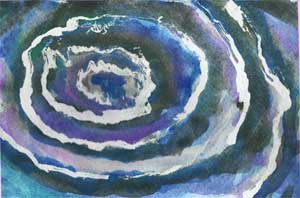
I have been entranced and informed by the image of water dropping as a metaphor for surrender, so I thought I should respond with a painting.

As usual, I fantasized about what and how I would like to paint before making the time and space for the actual painting session. I went to the store and bought some mastic so I could block areas of white on the paper. I remembered long-ago painting sessions where I could use a fine tipped brush to mark a curved edge and then gently tease the paint into a nearby wet area, watching as the water pulled the color across the paper. I remembered.

Then I sat down to paint. My right hand is now too weak to hold a brush. My left hand shakes. There could be no precise curved lines, no calm refined surfaces. I had expected the resulting image to teach me more about surrender. Instead, the process was my teacher.

It seemed each movement of hand and brush made expanding circles of anger, sadness, renewed determination and surrender.

"Enter as you wish to be in it," says Havi Brooks, one of my virtual teachers. I realize spending my year exploring Kind Promises is exactly that: I am attempting to learn the skills I will need for a life more affected by illness, disability and aging.

Expecting to be able to rely on a past skill and discovering it has gone are parts of the daily journey of significant illness or aging. I want to get good at surrender.

I want to get better at releasing my expectations as soon as I have them and entering into the beauty of the present moment. I want to discard the idea that beauty can only be found in smooth calm lines and celebrate the chaotic  rough loveliness in which I find myself.


Friday, April 16, 2010

Eight Things to do instead of giving up

In the last few weeks, I have come very close to giving up. Completely. Turn my face to the wall and wait to die. I have managed to change my mind, but it has taken work.

It was a tough winter. I spent the first week of December in the hospital and the following six weeks in a transitional care facility. (My family would later refer to it as "that place.") For most of that time, I couldn't do anything but lie there. No computer. No Internet access. I made a couple tortured drawings. Once home, I was visited by nurses three times a week. I was allowed out of the house for three things: doctor visits, church, and "the beauty parlor." While I was in that place, I thought of nothing but healing enough to get out of it. At home, I was surrounded by bits of my old life, but I didn't have energy or physical ability to take advantage of most of them…hence the impulse to give up.

Here's what saved me:

    1. Focus on one small thing that fills your heart.

      I went to a concert. (It was at a church... so I didn't even have to feel guilty about leaving the house www.globalharmony.org) There was one moment where the sound I was hearing was so wonderful that there was no room for anything else in my world—no room for any physical or emotional discomfort. There was only beauty. I thought: "Moments like this. Life is worth living for moments like this."

    2. Return to the present moment.

      I don't know how much of my former ability and energy will return. It is easy for me to get lost in worries about the future. That moment at the concert lifted me because I was nowhere else but the present moment. Pretending that the past and future exist is a game with very limited use. I've been writing for years about “making an internal gesture.” I finally know what I mean: paying attention to sensory information and leaving behind my mind chatter so that I am in the NOW.

    3. Feel the blessing.

      If someone else points out that there are people who have it much worse, I have to restrain my violent tendencies. Sometimes, though, I am reminded of these things naturally. For example, one of the pieces in the Global Harmony concert was about a Southeast Asian family fleeing violence. Hearing others' stories, I understand that—all things considered—I am blessed. When I feel that blessing, I want to go on.

    4. Go mad.

      In Douglas Adams book, Life, the Universe and Everything, hero Arthur Dent decides how to cope with being stranded on prehistoric Earth. He gets up one morning and announces "I will go mad!" After a particularly difficult day in my at-home recovery, I remembered Arthur’s coping mechanism and decided to try it. I had been thinking about things too realistically. I have an incurable disease and it's getting worse, hence: despair. Ruth Gordon said, "Never give up. And never, under any circumstances, face the facts.” In order for me not to give up I will have to ignore the facts. I will have to lose touch with reality. I must go mad.

    5. Spend time with a friend…the right kind of friend.

      I went to lunch with a friend and afterward felt much better. Not any friend would have left me feeling encouraged. My friend talked honestly of the difficulties in her life and how she copes with them. She is a 12-stepper and, as such, reminds me of the tools that come with that outlook on life. She is a deeply religious woman and the strength of her faith became a sort of splint for my own brokenness. Time with a good friend puts me back on the path to healing.

    6. Learn something new.

      I received an invitation to a free webinar. It was a subject in which I had only mild interest, but free is free and I had time. I listened to the webinar and took some follow-up video lessons. The subject matter had nothing to do with illness or medicine, so it was a nice change of pace. Absorbing information used my brain in a different way than when I am caught up in the emotions or tasks of dealing with my difficulties. In the book, Nation, Terry Pratchett's characters are recovering from a tsunami. One boy thinks about needing a "thin silver line" to draw him into the future. Learning something new is a thin silver line for me.

    7. Reinvent yourself.

      Having a major disruption in my usual schedule brings with it opportunity. I can reinvent myself. What is important to me? What gives me energy? What helps me move toward life? As I add activities into my life, I can choose which to reclaim and which to leave behind.

    8. Look for reasons not to give up.

      I started writing two weeks ago with five reasons not to give up. Because I was thinking about it, additional reasons have been jumping up and down, waving their arms and asking to be included. This has been fun and moments of fun, well, there's another reason not to give up.