Friday, February 10, 2012

Surrendering to the emotional and physical mess; defining patience

When I was in grad school, I learned the word "somaticize:" to convert anxiety (or other psychological distress) into physical symptoms.
I suspect I am a somaticizer.  I've had a stressful week and I feel pretty awful, physically. I don't work my day job on Fridays and I slept until 1 PM today after not having slept during the night.
This month I am living with the promise "I will surrender patiently."
Surrender to what? For now:  EVERYTHING.

There is, I suppose, a danger of being a doormat if I surrender to everything. It certainly wouldn't be a reasonable exercise in some people's lives. For me, for this month, I thought I would try it.
Sometimes it's useful to take my tangled mess of physical and emotional symptoms and tease them apart to see what's what. On the other hand, that's an easy way for me to get what a friend of mine calls "the paralysis of analysis." There is so much "wrong" that I end up (A) not knowing where to start or (B) with an overwhelming list of ways to "fix things."
Yesterday I was feeling overworked and judging myself to be handling it badly. Last night and today I am tired and headachy. That is the emotional and physical reality to which I need to surrender.
Sleeping in was a surrender. Shaving my to do list for today to almost nothing is a surrender. My job, for now, is to give in.
Patience?
Yesterday I was on the bus fuming about having too much work to do in too little time. "This is not surrendering patiently," I thought. Then I started wondering what I mean by patience.
Does patience mean I don't complain? Does patience mean I don't feel distressed? (I check the dictionary.) Well, shoot, that IS what patience means: "the bearing of provocation, annoyance, misfortune, or pain, without complaint, loss of temper, irritation, or the like."
Honestly, that doesn't sound like me. I am tempted to wiggle out of it… To choose another word. I have chosen these promises to expand, rather than continue, who I am.
What is the kate-ish road to patience?

When I am feeling as I did yesterday, I need to take time for a break… For breathing… Maybe even put the work aside and go out of the office for a talk with myself. I carry my wise self within me, but my prideful-monster-mind is louder and faster.

Like the old advice to count to 10 before saying something unfortunate, I need to leave myself space to recognize and process the emotions moving through me.
I go forward into the next week with two assignments:
  •  Continue to surrender to everything.
  •  Take a 10 breath* break whenever I feel the monsters rising.
* I fear that 10 breaths will take too long. I fear that if I cut it to four, I will rush. Even aiming for 10 will be helpful.

Friday, February 3, 2012

What do I want to learn about patients surrender?

My kind promise for February is to "surrender patiently."

I've written elsewhere about surrender and the difference between  giving in and giving up. Why did this promise call to me? What more do I want to learn about surrender?

I'm sure this is a response to my increasing difficulty with my hands. It is harder, these days, to accomplish the things I want to do. It doesn't take long for me to find myself in snarling frustration.

I want to practice surrender more frequently as a first instinct rather than a last resort. Too often, I try and try and try to get it done and, when something proves too difficult for me or the universe seems to rally against my effort, I surrender.

I had an interesting conversation last night with Sam Jasmin, radio host of Disabled and Proud. We talked about stubbornness and it's pros and cons. She's right that I accomplish more because of my stubborn streak. Unfortunately, I am not as nice to be around because of my stubborn streak.

I want to keep my determination and persistence but lose the short tempered meanness that seems to come with it. How would this be possible?

Off-the-top-of-my-head ideas:

  1. Take a calming breath between each effort."
    I seem to have spent the last six months retraining myself to breathe. Such a simple thing, yet I have been unconscious of it for most of my life. Now I am consciously trying to build a breath-calm-joy connection.
  2. Try three times and then (A) ask for help or (B) take a break or (C) reconsider.
    Maybe putting limits on my effort will also put limits on the escalation of my upset. This is definitely an experiment.
  3. Use "the next moment may also be a surprise."
    I discovered, during "forgiveness month" that my expectations do not serve me well. Maybe the same thing is happening here. My poor nerves are having trouble carrying signals. Why should I expect my hands to be adept? Acknowledging uncertainty may be a help.
  4. Try "everything belongs."
    In my philosophy/theology the universe is a stunning harmony, a whole. What we see as imperfect is part of that harmony. Everything belongs. This allows me, my increasingly dysfunctional hands, the ways I am clumsy and even my snarling frustration to belong. I need to remember that and be compassionate.

Oldie that I am, I can't help thinking of this song when I am thinking about surrender. Maybe singing a chorus or two will soften the brittleness.

Sunday, January 29, 2012

Miscellaneous Joys

In addition to inviting the enemies of joy, committing to exploring the idea of joy also has invited its allies. Despite a three-day migraine, this week has been one of splashing through puddles of joy.

Can I be joyful when I am in significant pain? Not exactly, but I was introduced this week ("by accident") to Carolyn Hobbs, author of Joy, No Matter What: Make 3 Simple Choices to Access Your Inner Joy. She speaks of the joy of living:

Have the intention: “I choose joy right now, even in situations where it seems impossible.”  Joy is always here in the present. Am I willing to hold all of my feelings… All of the conflict and stress… All of what I'm dealing with in this unlimited joy of being alive… Being awake… Being conscious. With each moment that we do that our quality of life changes…Our ability to be peaceful when everything feels in flux around us. Our capacity to feel joyful begins to grow and expand.
Several times, as I brought myself to mindfulness within my pain, I understood that the joy of living was supporting me… Like the diaphragm supports a deep breath.

It sounds just like me to ask the question, "what does joy sound like?" The people of New Zealand, with the help of Bobby McFerrin, gave me an answer. Here's the first song created entirely from the sounds of New Zealanders experiencing joy:


Visit

Blogger Kate Kresse of Believe Anyway has started the Joy Forwarding Project, where folks report what they've done to spread joy and thereby get inspiration from each other.

Finally, despite some grumbling over software limitations, I had a great time fingerpainting on my iPad this week, seeking to express joy.

Friday, January 20, 2012

Joy: Experiments in turning toward the light

When I decided to commit to these positive 12 kind promises, I knew that the monsters that roar against them would start biting at my heels.

This month, as I focus on joy, pain and weariness are weighing me down. "How can I be joyous," I wonder, "when I hurt and am exhausted?"

Deep breath.

I remind myself of the second part of the promise, "...without reason." There is a wonderful history of oppressed peoples living with joy and celebration amidst their troubles. I know the human spirit is capable of it; I just need to find my way.

Tools I can use:

Music: Country and gospel music provide me with a legacy of folks using music to transform pain. (I just spent far too long on YouTube watching versions of "Mourning into Dancing") Yesterday, I finished rewriting the lyrics of "Poor Poor Pitiful Me" to be about chronic illness. Music cheers me up and gives me energy.

Color: Speaking of cheering me up, color says joy to me. For the next week, I will try to make a joyful picture each day, "fingerpainting" on my iPad.

Movement: Moving our bodies gives us joy; that's why dancing is fun. It gets a little harder for me, as I can't voluntarily move much of my body. I can however chair dance. I can wiggle my body to music. This gets me music and movement simultaneously!

Play: a friend of mine sent me this video, reminding me of the importance of play. I am strategizing how to increase games and silliness in my everyday life.

There is a fullness in the moment of play that can be considered a way in which the universe is expressing its own magnificence and joy. In a moment of deep play, in a moment of deep love, in a moment of deep celebration, that's why the universe exists, There. Not for what it leads to, but for that moment. -- Brian Swimme

I'll report next week on the results of these experiments.

Friday, January 13, 2012

Joy is My Lesson

My kind promise to myself for this month is to live joyfully without reason.

In early January, I wondered whether to choose a different promise next. My mother died at the end of December. Perhaps joy would be hard to come by or an inappropriate thing for which to reach. I know my mother loved me and I know that a loving mother wants her child to be happy. I added the words "without reason" to this promise precisely because I want to learn how to be joyful in the midst of hardship, how to live with joy despite the circumstances. So here we go.

My first task, with each of these themes, is to search for appropriate quotes and load them on Twitter. (Yes, I use a Twitter buffer called Twuffer rather than posting live.) As I was puzzling how to be joyful, I ran across this quote:


It made me think of A.J. Muste's famous line, "there is no way to peace—peace is the way."  It will not serve me to overthink this joy thing.

There is no way to joy. Joy is the way.


(I need to lose my inner Mary Poppins!)

Forgiveness and Chronic Illness

I can't leave the topic of forgiveness without saying a few words about forgiveness and chronic illness.

It is easy for me to feel I did something that caused me to become ill or, since  my illness is progressive, something that's making it worse. Perhaps if I hadn't been so stressed as a 20-year-old, the disease would've taken longer to appear. Perhaps if I'd stayed on that special diet, I wouldn't be using a wheelchair today. You get the idea.

Cindy Hively, a teacher of mine, recently wrote "No matter what some people may say, your illness is not your fault!" Reading those words, I felt a knot inside me loosen.

As a person who faces health issues...
I forgive myself. I have done my best.
I forgive my body. It has carried me through this life, responding as well as it can to the changes within it.
I forgive healthy people who walk without thinking about it, who complain that they ate too much, who type on keyboards without realizing the miracle.
I even forgive the disease. Some DNA quirk responded to an environmental trigger and here we are.

No harm was meant.

Forgiving with wild abandon means that I embrace us all tenderly and love us immensely.

Wednesday, January 4, 2012

Forgiveness and Letting Go

Whether it's forgiving myself or someone else, I've discovered it's a practice.

I love practice. Have I mentioned that before? Forgiveness is built into practice.

  1. I plan to do something. (Intention)
  2. I make an effort to do it. (Action)
  3. It doesn't go the way I think it "should" go. (Judgment)
  4. I let go of my ideas about what should have happened. (Mercy)
  5. I reset or re-envision my intention. (Resilience)
  6. Repeat.
Watching myself around forgiveness, I have found an unfortunate tendency to get stuck on step three. I judge. I try to let go, but it really shouldn't have gone the way it did and it's really not my fault, but if I'd only done it differently…

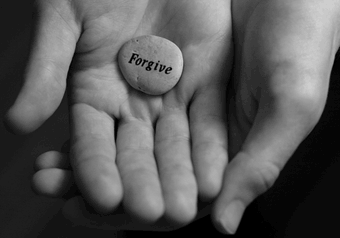
The image that came to mind is of carrying around a stone. I set it down for seconds and then, compulsively pick it up again.

Forgiveness becomes a practice of letting it go and letting it go and letting it go.

Angel Sighting

I first heard Mary Johnson's story on the CBS news. A short time later, I was delighted to watch it from a different angle as as a trailer promoting one of my favorite art experiments, The SMOOCH Project.


Mary teaches me that "unforgivable" may not exist.